




What I Wish I'd Known in My First Year as a Steel Detailer
What I Wish I'd Known in My First Year as a Steel Detailer
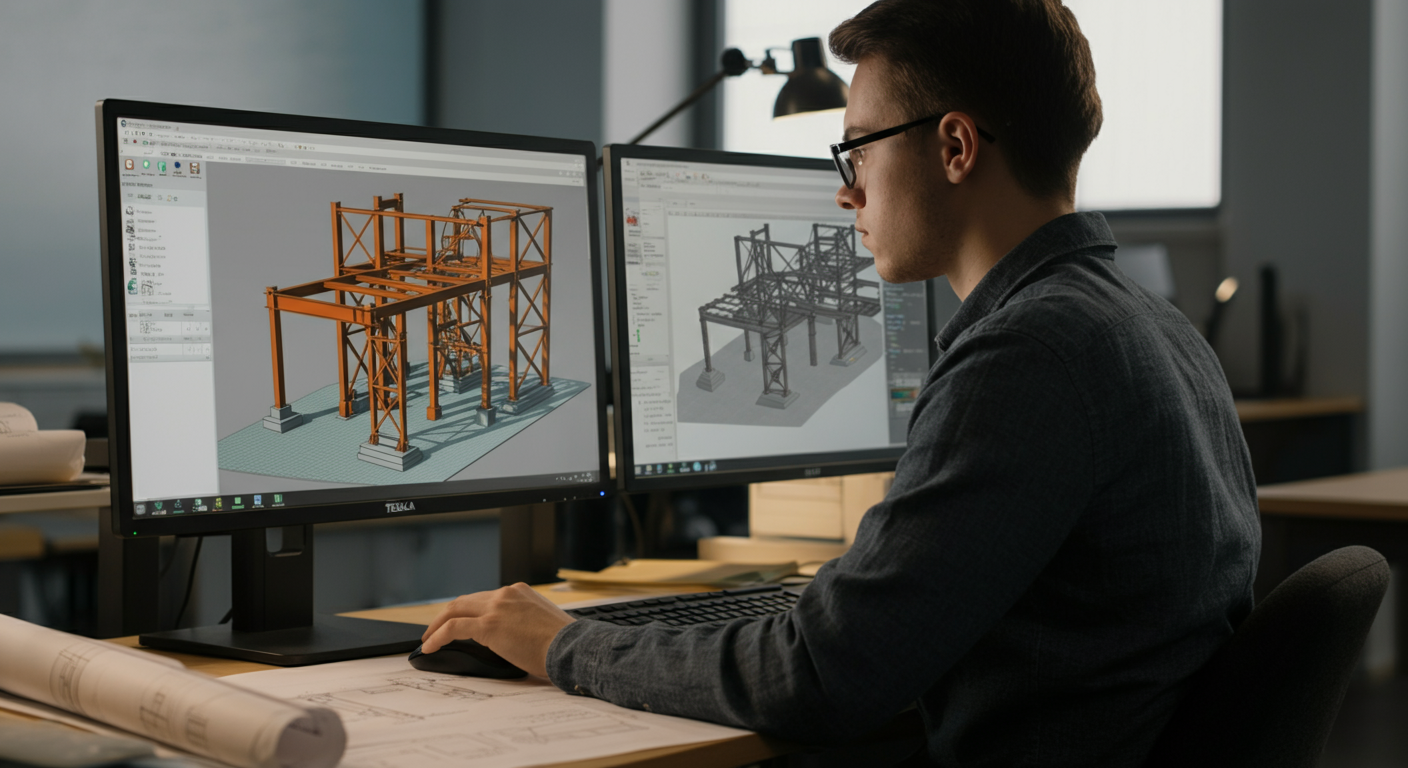
Nobody gives you a useful map for the first year. You learn Tekla or SDS/2, you run through the tutorials, and then a project lands on your desk and you realize the software was the easy part. The hard part is understanding what you're actually building — why that connection is designed the way it is, what the fabricator needs from that shop drawing versus what looks clean on screen, and how to handle the moment when the structural documents contradict themselves and the schedule doesn't have room for an answer. The first year in steel detailing is a compression of lessons that usually takes three years to absorb. Most of those lessons nobody writes down. This post is the version I would have handed myself on day one — not a tutorial, not a software guide, but the actual things that determine whether you become competent fast or spend two years producing work that needs to be corrected by someone downstream.
The Gap Between Software Training and Project Competence
Tekla Structures is a sophisticated tool. You can spend months learning it and still only be scratching the surface. What nobody says clearly enough at the start is this: software proficiency and structural understanding are two completely separate skill sets, and in the first year, most people develop the former while badly underestimating the importance of the latter.
You will meet detailers who can build a model fast, punch out drawings with clean callouts, and produce a submittal package that looks professional. And you will watch those same submittals come back from the EOR covered in comments — not because the drawings were formatted wrong, but because the underlying decisions were wrong. The column cap plate was sized from a previous job without checking the bearing requirement. The shear tab was copied from a similar bay but the loading wasn't similar. The brace connection was modeled to match the geometry but nobody checked the gusset against the AISC 360 provisions the EOR used.
Software does not know structural engineering. You have to bring that. The faster you accept that gap and start filling it — by reading, by asking, by studying actual AISC Steel Construction Manual examples — the faster you become someone who produces work that doesn't get corrected downstream.
Read the Structural Drawings Before You Model Anything
This sounds obvious. Most junior detailers still don't do it. They open Tekla, start inputting member sizes from the framing plans, and begin building. Then three weeks in they discover a general note on the structural drawings that governs all HSS column base plate design, or a detail on sheet S-7 that specifies a non-standard connection type for all moment frames, and now they're rebuilding work.
Read the structural drawings cover to cover before you touch the model. Start with the general notes and typical details. Read the specification sections that the EOR references — AWS D1.1 for weld quality, RCSC for bolted connections, AISC 360 for member and connection design. Understand what the EOR has decided versus what they've left to the detailer or the fabricator's engineer of record.
Pay attention to the seismic design category. An SDC D project under AISC 341 has prescriptive requirements for moment connections, column splices, and brace geometry that will govern dozens of your detailing decisions. If you don't know you're on a seismic job when you start modeling, you'll model the wrong thing.
The structural documents are the contract. Everything you produce has to be traceable back to them. Learn to read them like the primary source they are.
How to Ask Questions Without Looking Incompetent
You will have questions. Every project generates questions. The detailers who advance quickly are not the ones who never ask — they're the ones who ask well.
Asking well means doing the work first. Before you write an email or pick up the phone, document what you know, what you've checked, and specifically what the conflict or ambiguity is. "The framing plan shows a W16x40 but the schedule calls out a W16x45 at this gridline — which governs?" is a good question. "What size is the beam at B3?" is not.
When you ask well, two things happen. First, the person you're asking — whether it's your senior detailer, the project manager, or eventually the EOR — understands that you've done the work and are bringing them a real problem. Second, half the time you'll answer your own question in the process of framing it clearly.
The detailers who don't ask are the ones who guess, model the guess, produce drawings from the guess, and send the fabricator to the shop floor with wrong information. That costs real money. A question costs nothing.
The RFI Is Your Most Important Document
Learn early what an RFI is for and how to write one. A Request for Information is not just an administrative formality — it is the formal mechanism by which you document a conflict, an ambiguity, or an omission in the contract documents and request a resolution from the EOR or the owner's representative.
An RFI protects you. It protects your fabricator client. It creates a paper trail that says: this condition was identified, this question was asked, this answer was received, and this is why the work was done the way it was done.
A good RFI is specific, references the exact drawing sheets and detail numbers in conflict, states clearly what you need to know and by when, and proposes a solution where one is apparent. EORs appreciate detailers who come with a suggested answer rather than just a question. It saves them time and demonstrates that you understand the structural intent.
Get comfortable writing RFIs early. Understand your firm's process for logging and tracking them. A fabricator's submittal window is tight; an unanswered RFI sitting in someone's inbox is a schedule risk and a liability.
Reading a Connection Design
The EOR's connection design tables and typical details are telling you something. Learn to read what they actually decided and why.
When you see a bolted shear connection with a specified number of 3/4" A325 bolts, the EOR ran a calculation. That count isn't arbitrary. When the base plate dimensions are called out with specific anchor bolt pattern and weld size, those are outputs of a demand-versus-capacity check. Your job as a detailer is not to second-guess those numbers — it's to implement them correctly, and to recognize when the geometry you're modeling is inconsistent with what was designed.
That means knowing enough about connection behavior to flag problems. If you're detailing a beam-to-column moment connection and the cope depth required by the framing geometry is reducing the web area in a way that looks problematic, you need to recognize that and ask — not model it and ship it. You don't have to run the calculation yourself. You have to know enough to know when something needs to be checked.
The Fabricator Is Your Customer
Steel detailing exists to serve the fabricator's shop floor. That is the purpose of a shop drawing — not to look organized on screen, not to impress the EOR, not to satisfy a checklist. The machinist, the fitter, the welder, and the painter need to be able to read your drawing and produce the correct piece without ambiguity.
This means dimensioning clearly and completely. It means calling out weld sizes, bolt grades, surface prep requirements, and camber specifications in the right places. It means anticipating the questions a fitter is going to have when the drawing hits the floor — and answering them before they're asked.
It also means understanding the fabricator's sequence. When do they need anchor bolt drawings to keep concrete pours on schedule? What's the lead time on their HSS material? Are there long-lead W-shapes that need to be released before the erection package is complete? A detailer who understands fabricator operations delivers work that slots into their production workflow. One who doesn't creates friction at every step.
Triage on Concurrent Projects
In the first year, everything feels equally urgent. Multiple projects land simultaneously, every senior detailer has a different opinion about priority, and the loudest request tends to win your attention.
Learn to triage by constraint, not volume. The constraint that matters is usually downstream dependency: what piece of work is blocking the fabricator from cutting steel, submitting to the EOR, or releasing material? Start there. A 20-sheet submittal that's due Friday for EOR review is a different priority than a one-off RFI response that can wait until Monday morning.
When in doubt, communicate. Tell your project manager what's on your plate and ask which constraint is real. Experienced people can reprioritize work. They can't reprioritize a missed submittal date.
What Good Mentorship Looks Like — And How to Find It
Good mentorship in steel detailing is specific. It's not someone watching over your shoulder while you model — it's someone who reviews your connection calls before they go out, who redlines your first few submittals and explains why, and who answers the question "why is it done this way" instead of just "it's always done this way."
If that person isn't assigned to you, find them anyway. Identify the senior detailer whose work comes back clean from EOR review. Ask if you can look at their submittals. Bring them specific questions on your active projects. Most experienced detailers will help a junior who comes prepared and serious.
Read the AISC Steel Construction Manual. Work through the connection design examples. The goal in the first year isn't to become a connection engineer — it's to develop enough structural literacy that your instincts flag problems before they become fabrication errors.
NRSteel works exclusively with fabricators on commercial and institutional structural steel projects across the Southeast and nationwide. If you're building out your detailing team or looking for a detailing partner who can carry your project from IFC to approved submittals without the friction, get in touch to talk through your next job.