




The Structural Steel Model as a Construction Management Tool
The Structural Steel Model as a Construction Management Tool
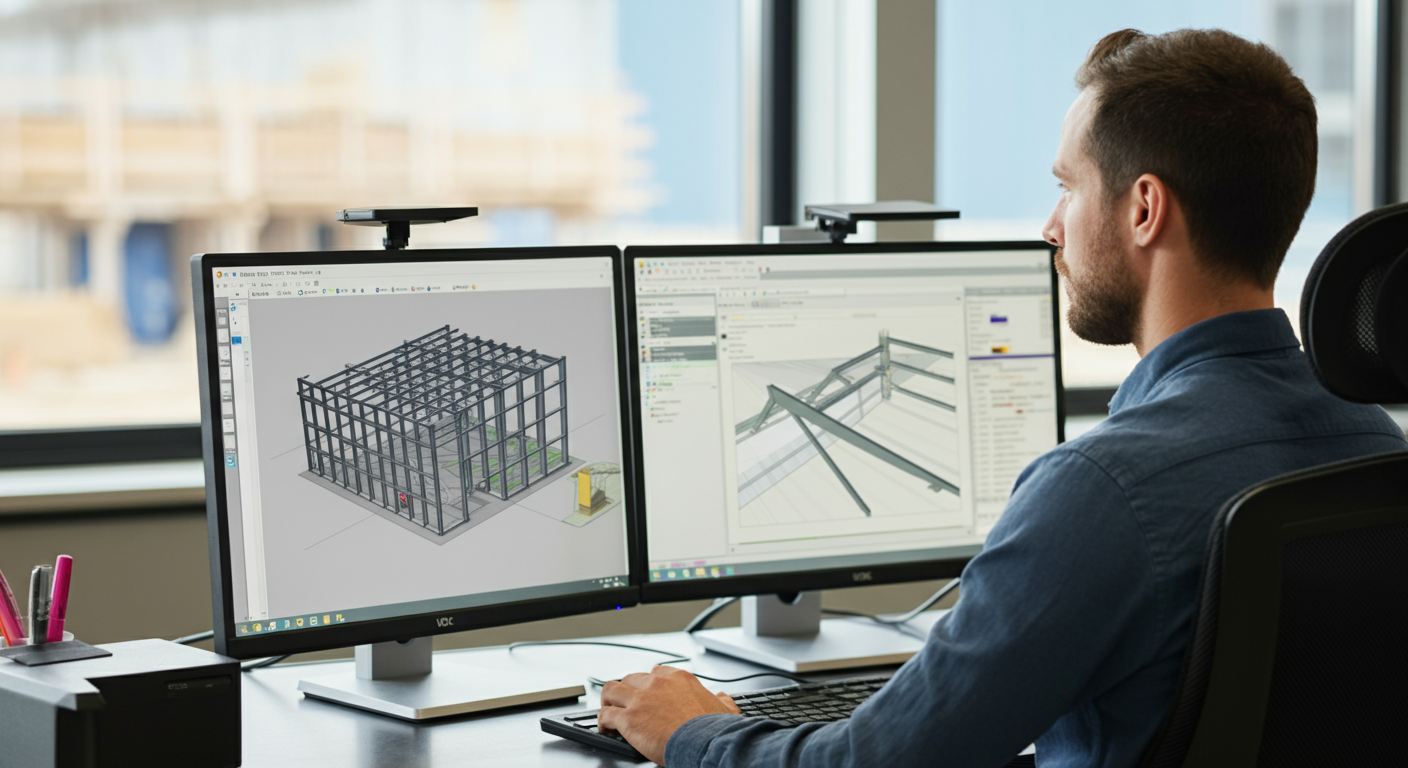
The steel model doesn't stop being useful when the shop drawings are approved. On projects where GCs are doing real construction management work — not just collecting submittals — the structural steel model is one of the most information-dense assets on the project. It knows every member's weight, profile, length, and position. It knows the connection configuration at every node. It knows what gets erected before what. The question is whether the model was built to a standard that makes that information extractable and trustworthy, or whether it was built to the minimum standard needed to produce acceptable shop drawings. Those two models look the same on paper. They perform very differently when a GC's VDC manager tries to pull a crane pick list or run a 4D sequence animation. This post covers the specific ways forward-thinking GCs are using steel models beyond fabrication, and what it means for how fabricators should be evaluating their detailing partner's technical standards.
Why a Well-Built Steel Model Is Valuable Beyond the Fab Shop
A Tekla Structures model built to production-grade standards is not just a drawing generator. Every object in the model carries attributes: ASTM grade, section size, length, weight, finish specification, assembly mark, position coordinates. When those attributes are populated consistently and correctly — not just enough to produce a correct shop drawing, but enough to query against — the model becomes a live database of the structural steel package.
GCs who understand this are starting to make explicit requests of their steel contractors early in the process: deliver the model in a format we can reference in our VDC environment, and make sure the attributes are complete. The fabricators who can accommodate those requests — because their detailing partner builds to that standard by default — have a competitive differentiator. The fabricators whose detailer produces clean drawings but a model full of null fields and inconsistent mark logic find out late, when it matters.
Sequencing and 4D Simulation: Attaching Schedule Data to Model Objects
4D BIM ties schedule data to model objects so that a project timeline becomes a spatial animation — the building assembles itself on screen in the sequence it will be built in the field. For structural steel, this means erection sequences, piece-by-piece if needed.
To make this work, the steel model needs consistent, queryable object attributes that the scheduling software (Navisworks, Synchro, or similar) can read and map to activity IDs. Assembly marks need to follow a logic that corresponds to erection phases. Members need to be modeled as discrete objects — not merged or grouped in ways that prevent individual scheduling. The model needs to export cleanly to IFC or NWC without collapsing assembly relationships.
A detailer who understands 4D simulation structures the model with that export in mind from the start. A detailer who doesn't will produce a model where the GC's VDC team spends days manually reworking the object hierarchy before a single activity can be linked. That rework has a cost, and it falls on the GC's schedule.
Crane Pick Planning Using the Model
On most commercial structural jobs, the crane plan is one of the more consequential pre-construction decisions. Pick radius, boom configuration, and counterweight setup depend on knowing the weight and center of gravity of every assembly being lifted — including multi-piece picks where two or more members are ganged together for efficiency.
A properly built structural steel BIM model can produce this data directly. In Tekla, assembly weights are computed from section properties and material density. The model knows the weight of every beam, column, and connection component. A detailed crane pick list — member ID, assembly weight, center of gravity offset, approximate pick point based on connection geometry — can be extracted from the model rather than calculated manually from drawing dimensions.
This matters most on tight urban sites and on projects with long-span roof structures where individual member weights push equipment limits. A detailer who has worked closely with erectors understands how this data gets used and structures the model output accordingly. One who hasn't may hand off a model where the weight data is present but inconsistently populated, requiring verification against section tables before the rigging contractor can use it with confidence.
Quantity Takeoff from the Model: What's Reliable and What Isn't
GCs and owners use model-based quantity takeoff for several purposes: early budget validation, change order substantiation, and material delivery tracking. The steel model is capable of generating accurate tonnage by phase, by floor, or by structural system if the model is clean.
What a GC can reliably pull from a well-built steel model: total tonnage by section type, piece counts by assembly mark, member lengths for anchor bolt or embed schedules, and bolt counts by diameter and grade for procurement tracking.
What still requires manual verification: connection hardware that isn't fully modeled (loose plates, shim packs), weld filler metal estimates, field bolt quantities where tolerances affect count, and any scope that was detailed outside the primary model. A responsible detailer will be clear about what's in the model and what isn't — and will document the scope boundaries so the GC doesn't build a budget off an incomplete quantity set without knowing it.
Clash Coordination as Pre-Construction Risk Management
Most GCs have been through enough federated model coordination to know that clash detection is only as useful as the models going into it. A steel model with incorrect beam elevations, missing connection material, or columns not extended to their full connection height will produce missed clashes — interferences that show up as surprises in the field rather than RFIs at the desk.
The structural steel model is typically the backbone of the federated coordination model. Mechanical, electrical, plumbing, and architectural models are all coordinated against it. If the steel model is accurate to the connection level — including clip angles, gusset plates, base plate dimensions, and anchor bolt projection — the coordination model catches real interferences. If it's a schematic centerline model, it misses everything that happens within 6 inches of a connection.
On projects in SDC C or D with moment frames and brace connections, the connection geometry is complex enough that failing to model it accurately produces coordination misses that affect fireproofing access, mechanical clearances, and ceiling plenum space. The cost of those misses — field labor, schedule impact, potential structural modification — dwarfs the cost of a more detailed original model.
Site Logistics: Delivery Sequences and Laydown Planning
The steel model knows the erection sequence if the detailer builds it that way. That sequence directly informs how steel should be delivered to the site — what needs to arrive first, what can be staged off-site, and how loads should be organized to minimize double-handling.
GCs on tight sites use the model to plan laydown areas by erection phase. If the perimeter columns and anchor bolt work for the north bay are going in first, the model can confirm which pieces belong to that phase and what size trailers are needed. On projects where the site is too small for on-site steel storage, the delivery sequence derived from the model becomes the just-in-time logistics plan.
This is an area where the detailer's relationship with the erector adds real value. A detailing firm that regularly works with erectors in the Southeast understands how they prefer to sequence picks and what drives their efficiency on the ground. That knowledge gets baked into how assembly marks are assigned and how the erection sequence is communicated in the model.
What Separates a Fabrication Model from a Construction Management Model
The difference isn't visible in a plan view. Both models produce the same shop drawings. The distinction shows up in attribute completeness, object hierarchy, mark logic, and export fidelity.
A fabrication-only model is built to answer one question: does this drawing accurately describe what needs to be fabricated? A construction management–grade structural steel BIM model answers additional questions: what does this piece weigh, when does it get erected, where does it land, and what does it connect to? Those questions require a different standard of model hygiene — consistent attributes, clean IFC exports, mark logic that maps to schedule phases, and connection geometry that's complete enough to coordinate against.
The detailer who builds to the higher standard doesn't necessarily take longer or charge more. They're working from discipline, not from extra hours. The difference is experience and intent.
What a GC Should Ask Their Steel Contractor
Before you're deep into a project and making assumptions about what the steel model can do, ask directly:
- What format will the model be delivered in, and can we access it in Navisworks or our VDC platform?
- Are assembly weights populated consistently throughout the model?
- What's the mark logic — does it map to erection phases or just to shop sequence?
- What connection material is included in the model, and what's excluded?
- Can you provide a member weight report broken out by erection zone?
A detailer who has supported GC coordination work will answer those questions without hesitation. One who hasn't will get vague. The answer tells you a lot about what kind of model you're actually getting.
If you're evaluating detailing partners for your next project — particularly one where your VDC team expects to work directly with the steel model — contact NRSteel for a scope review. We work exclusively with fabricators on commercial and institutional structural projects across the Southeast and nationwide. Every model we deliver is built to a standard that supports downstream GC use, not just submittal approval.