




Steel Fabricators in North Carolina: What to Look for in a Detailing Partner
Steel Fabricators in North Carolina: What to Look for in a Detailing Partner
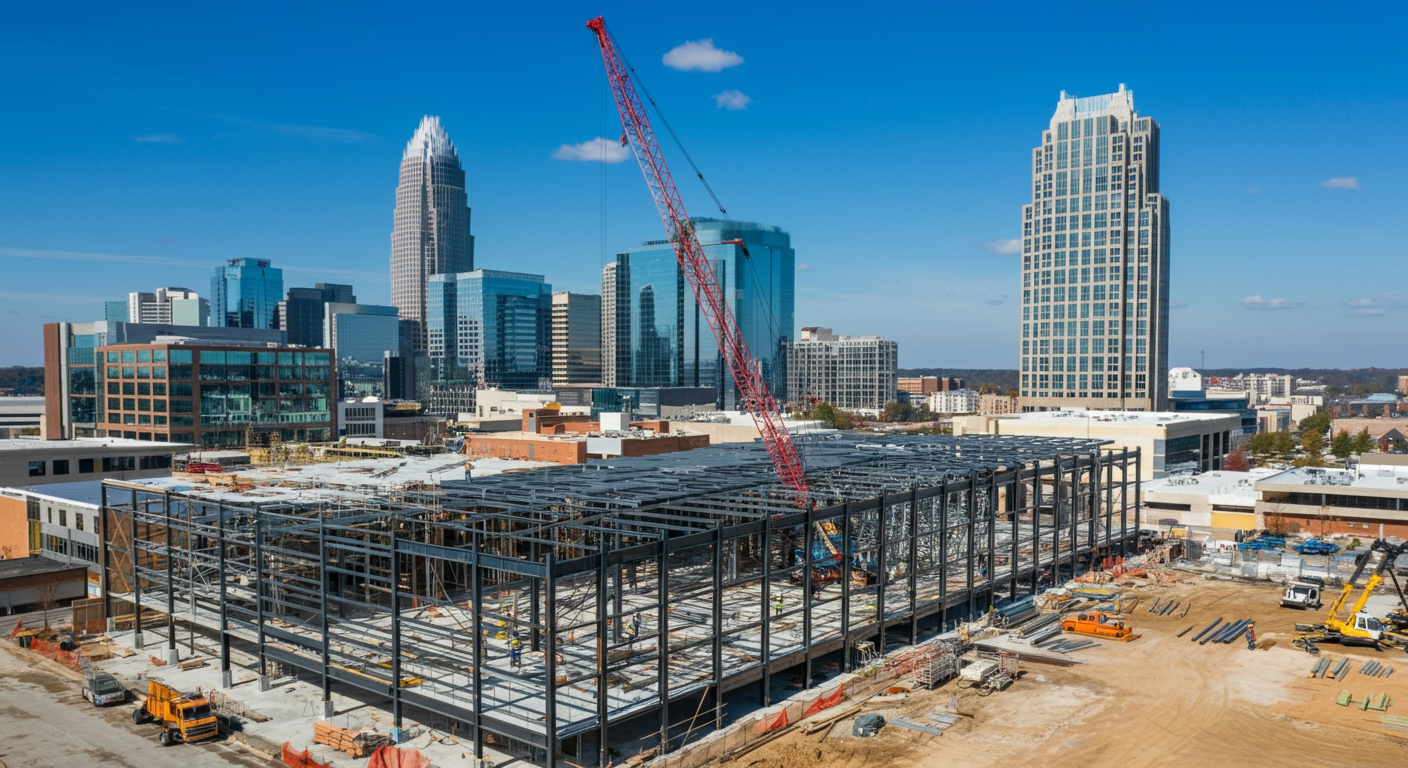
North Carolina's construction market has been running hot for three years and doesn't show signs of slowing. Data centers along the I-85 corridor. Healthcare facilities in every major metro. Multifamily mixed-use filling in the Triangle and the Triad. Light industrial distributed across the Piedmont. Every one of those projects has structural steel, and every one of those projects needs shop drawings, erection drawings, and connection details that match what North Carolina actually requires — not a generic package templated for a different state's code adoption cycle. If you're a fabricator based in NC or regularly taking NC work, your detailing partner needs to know this market, not just structural steel in the abstract. Here's what that means in practice and how to evaluate whether the firm you're talking to actually qualifies.
North Carolina's Structural Steel Market Right Now
The growth corridors are well established at this point. Charlotte continues to expand outward — light industrial tilt-up gives way to heavier structural packages as you move into suburban commercial and the healthcare campuses anchored around Atrium and Novant. The Triangle is absorbing an unusual project mix: data center shells that look simple until you see the equipment loadings and the seismic strap requirements, plus dense mixed-use wood-over-steel podium structures where the steel package is small but the coordination surface is enormous. The Triad is seeing steady industrial and warehouse work. The Wilmington coast has its own flavor — wind exposure categories that matter at the connection level, coastal corrosion environments that affect material specifications, and a building department ecosystem that operates differently from the metro jurisdictions inland.
The common thread: every one of these project types puts different demands on a detailing firm. A shop drawing set for a data center in Mebane is not the same animal as a hospital addition in Greensboro or a distribution facility in the I-40 corridor. The detailer needs fluency across all of them.
What NC Projects Actually Demand from a Detailer
North Carolina is currently on the 2018 IBC cycle with state amendments — and those amendments are not trivial. The NC State Building Code modifies occupancy classifications, fire-resistance assemblies, and certain structural provisions in ways that a detailer working from the base IBC without NC-specific awareness will miss. If your detailer is calibrated to a different state's adoption cycle, those discrepancies surface during plan review, not before.
Under ASCE 7, North Carolina spans a meaningful range of design conditions. Seismic Design Category varies across the state — western NC carries higher seismic demand than the coast, and projects in SDC C or D require detailing attention to connection ductility and special inspection requirements that simply don't apply on a low-seismic job. Wind exposure categories along the coast shift connection loads in ways that matter for anchor bolt design and moment connection geometry. A detailer who's been doing work in the Midwest or mid-Atlantic and picks up a Wilmington job needs to recalibrate, or you'll be issuing RFIs to your own detailer asking why the base plate didn't account for the correct wind uplift.
The Local Advantage — What It Actually Means for Your Shop
"We support all time zones" is a marketing line. What it means in practice is that nobody on the project has ownership of your RFI at 3:30 PM on a Friday when erection starts Monday. Same-timezone availability is a project management structure, not a soft benefit. When a field question comes in late afternoon, a local detailer can close it the same day. An offshore shop routes it through a coordinator, queues it overnight, and returns an answer the following morning — after the erection crew has already made a decision in the field.
Beyond turnaround time, there's the coordination surface. NC fabricators who work with NC-based EORs repeatedly develop working relationships that carry project-to-project value. The detailer who has already delivered three projects for a particular structural engineering firm knows that firm's connection standard preferences, their typical weld specifications, and how they want their submittals organized. That institutional knowledge doesn't exist in a shop that's never worked this market. You absorb the learning curve.
In-person coordination is real when both parties are in-state. Pre-construction meetings, kickoff calls with the EOR, site visits when erection sequencing questions come up — these happen when the detailer is a two-hour drive away, not a twelve-hour flight.
Five Criteria for Evaluating a Detailing Partner on NC Work
1. Familiarity with NC Building Code Amendments
Ask directly: what IBC cycle is North Carolina currently on, and what state amendments are material to structural steel detailing? A qualified detailer answers that from memory. If they need to look it up, they haven't been doing NC work.
2. Experience with NC-Based EORs and Their Standards
EORs who regularly work in North Carolina — particularly the larger structural firms active in Charlotte, Raleigh, and Greensboro — have established connection standards, preferred bolt specifications, and submittal formats. A detailer with a track record of NC work knows these firms and knows how to move through the approval cycle efficiently. Ask for specific project references, not general claims.
3. Real-Time Response During NC Business Hours
This is testable. Send an email at 4 PM on a Thursday. Call the named contact. If you reach a coordinator who routes your question to a production team in another time zone, you've answered your own question. Real-time availability means a direct line to the person doing the work, during your business day.
4. Project Portfolio in NC Project Types
"Commercial experience" is not a differentiator. Ask about specific project types: data center structural packages, healthcare additions with occupied-facility sequencing constraints, mixed-use podium steel, light industrial with large clear-span joists and metal deck. Ask about W-shape and HSS experience, joist and deck coordination, connection design under AISC 360. The portfolio should map to the work you're actually placing.
5. A Single Named Contact Through IFC
Scope creep, revision cycles, and RFI resolution all go better when one person owns the project from kickoff to IFC. The moment your detailing firm starts rotating contacts or routing you through account managers, accountability diffuses. Structural steel detailing NC fabricators should be asking: who is my named contact, are they the person doing the work, and what's their direct number?
The Offshore Trap for NC Fabricators
Price per drawing is the wrong metric. The math that matters is total project cost: revision cycles, RFI turnaround delays, fabrication errors caught in the shop vs. errors caught in the field, plan review comments that require resubmittal. On a project with NC-specific code requirements, an offshore shop that doesn't know the NC IBC amendments, hasn't worked with the project EOR, and is operating on a twelve-hour delay when questions surface will run up revision cycles and turnaround costs that erase any rate advantage. The risk is disproportionate when the project has state-specific nuance — which NC projects do.
This isn't a theoretical concern. Fabricators who have absorbed re-work costs because a shop drawing set missed an NC-specific requirement know exactly what it costs.
What the NC Market Looks Like in 2026
The data center pipeline along I-85 and in the Research Triangle Park corridor is real and sustained. These are structurally intensive packages — heavy column grids, significant equipment support steel, demanding coordination with MEP and electrical — and they're running on aggressive schedules driven by client occupancy requirements. Healthcare construction is similarly active: expansion projects at established campuses, freestanding MOBs, and surgery center fit-outs that require steel packages delivered on tight submittal windows.
The multifamily and mixed-use pipeline in the Triangle shows no sign of easing. These projects are often podium structures where the steel scope is limited but the coordination surface — with concrete, wood framing, curtain wall — is extensive. The detailer needs to track more than just steel.
For fabricators, this market environment means full books and limited tolerance for friction. Every revision cycle that can be prevented at the detailing desk is an uninterrupted production run on the shop floor. A good detailing partner protects your schedule, not just your submittal package.
NRSteel is based in North Carolina and works exclusively with steel fabricators on commercial and institutional structural projects across the Southeast. If you're evaluating detailing partners for your next NC project — or looking for a firm that already knows the market you're working in — get in touch to discuss your next job.