




Connection Design Errors: The Most Expensive Mistake in Structural Steel Fabrication
Connection Design Errors: The Most Expensive Mistake in Structural Steel Fabrication
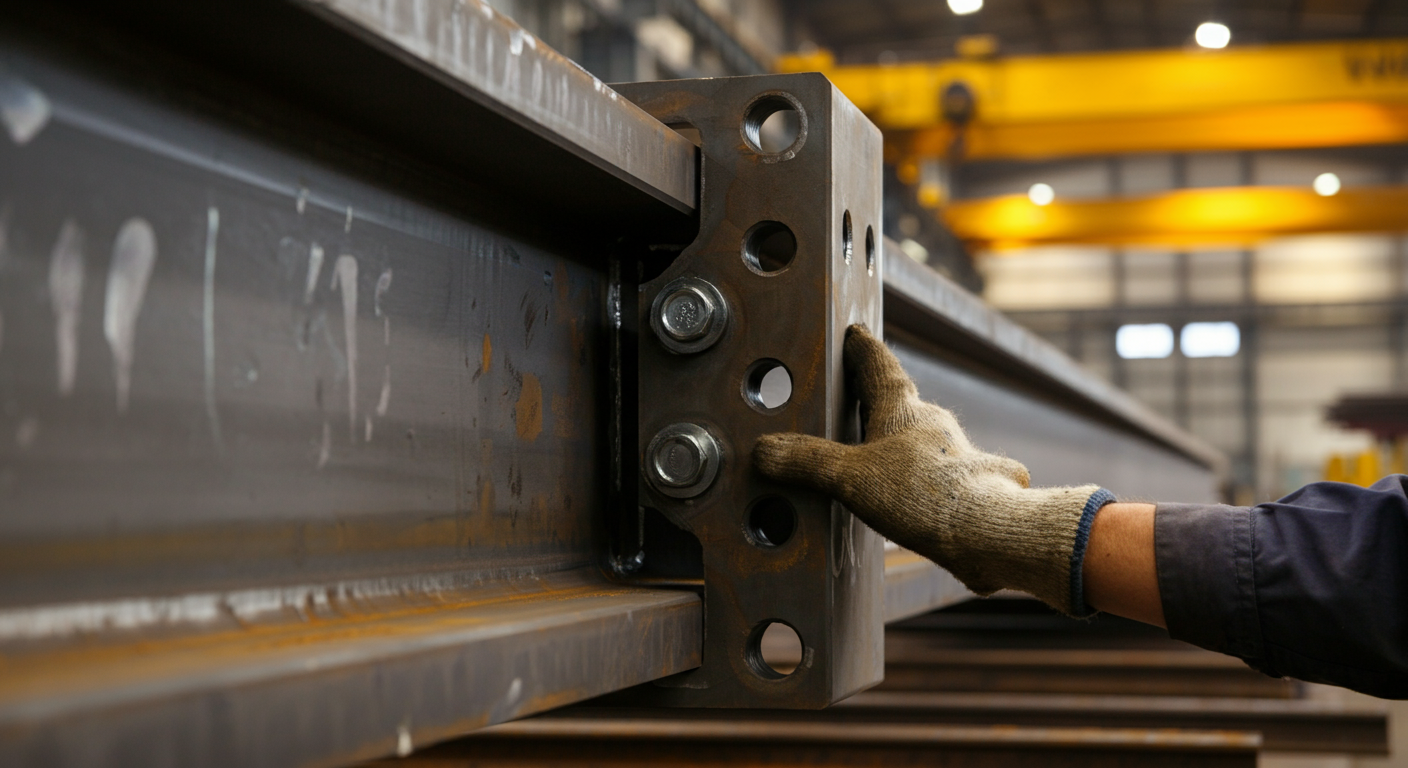
A dimension error in a shop drawing is annoying. It gets caught — usually in QC, sometimes in the field — corrected, and documented. The cost is a few hours of rework and a revision to the drawing set. A connection design error is a different category of problem entirely. A bad weld size, an undersized bolt group, a cope that creates a net section failure condition the detailer didn't check — these errors don't announce themselves at the drawing desk. They propagate through fabrication. Parts get cut to geometry that can't carry the load. Holes get punched in patterns that won't assemble. Welds get deposited to a joint that hasn't been sized for the actual demand. By the time the error is caught, you're not looking at a revision — you're looking at rework, schedule loss, and depending on how far it went, a liability conversation with your EOR. Connection design errors are the most expensive mistake in structural steel fabrication, and they almost always originate in detailing.
The Cost Profile of a Connection Error
Most fabrication errors have a natural containment point. A dimension error on a W8x31 beam gets flagged during QC, the shop drawing gets revised, and the cut gets remade. Expensive? Marginally. Catastrophic? No.
Connection errors don't have that containment profile. A connection geometry error — wrong bolt pattern, undersized fillet, inadequate cope clearance — gets embedded into the shop drawing and stamped through IFC. From there, it flows downstream without friction. The CNC table runs the holes. The fitter lays out the weld joint. The welder deposits metal to the print. Every labor hour applied to that part is being applied to a piece that will have to be reworked or scrapped.
Multiply that across a beam line. A typical mid-size commercial project might have fifty identical beam-to-column connections run off the same detail. If that detail is wrong, you're not fixing one connection — you're fixing fifty. The direct rework cost on a single misdetailed standard connection type can run into five figures once you account for cut-to-scrap material, re-punch or re-drill labor, re-fit, re-weld, and re-inspect. If the error involves structural adequacy rather than geometry, the EOR has to re-review, the schedule slips, and someone is writing an explanation to the GC.
How Connection Errors Originate in Detailing
Connection errors are rarely random. They cluster around five specific failure modes in the detailing process.
1. AISC Table Application Without Load Verification
The AISC Steel Construction Manual provides standard connection tables for shear tab, double-angle, and end plate connections. These tables are enormously useful — and routinely misapplied. A detailer who selects a shear tab size from a table without verifying it against the EOR's specified reaction load is not doing connection design. They're doing pattern matching. When the actual demand exceeds the tabulated capacity, the connection is undersized and the drawing looks correct to anyone who doesn't run the numbers.
2. Weld Sizes Below AWS D1.1 Minimums
AWS D1.1 establishes minimum fillet weld sizes based on the thicker part joined. A detailer who sizes welds based on load demand alone — without checking against the minimum size provisions in Table 6.1 — can produce a weld callout that satisfies the load calculation but violates the code minimum for that joint configuration. These errors pass drawing review because the weld size looks plausible. They only surface if someone runs the AWS check independently.
3. Undersized Bolt Groups
Bolt pattern adequacy is a calculation, not a lookup. For a simple shear connection with no eccentricity, the standard tables cover it. For any connection with moment demand, combined loading, or eccentric shear, the bolt group has to be designed for the actual demand using instantaneous center methods or direct tension/shear interaction. A detailer working from standard details who doesn't recognize when the connection geometry has moved outside the table's assumption set will undersize the bolt group — and nothing in the visual review of the drawing reveals the error.
4. Cope Geometry and Net Section
Coping a beam for clearance is routine. Checking the coped section for block shear, flexural yielding at the cope, and local buckling is not always routine — and in some shops, it's not happening at all. A cope that looks fine on the drawing can create a net section failure condition at the reduced flange area. This is a documented failure mode with case studies behind it. The AISC check for coped beams involves the cope depth, cope length, beam depth, and the web properties at the reduced section. Skipping that check produces a connection that looks fabricatable and is structurally inadequate.
5. HSS Wall Thickness for Punched Connections
HSS members are increasingly common in commercial structural framing — braces, columns, architecturally exposed elements. Punched connections to HSS require verification that the wall thickness is adequate for the punching shear demand and that the connection geometry doesn't create a local wall failure condition. An HSS4x4x1/4 and an HSS4x4x3/8 look nearly identical on a drawing. If the connection was designed for the heavier wall and the drawing shows the lighter section — or if the wall thickness was never checked against the connection demand — the fabricated part may not perform.
Why These Errors Survive Submittal Review
EOR submittal review is a conformance check, not an independent structural analysis. The EOR is reviewing shop drawings to confirm they reflect the design intent shown on the contract documents. They are not re-running every connection calculation. They are not verifying that the detailer's weld sizes satisfy AWS D1.1 minimums for every joint configuration. They are checking that the geometry matches, the member sizes are correct, and the overall layout conforms to the structural drawings.
This is the appropriate scope of submittal review, and fabricators need to understand it. The phrase "EOR reviewed and approved" does not mean "every connection has been independently verified for structural adequacy." It means the drawings conform to design intent as-reviewed. If the detailer's connection calculation has an error, that error is typically not visible in the submittal review process.
What Rework Actually Costs on the Fabrication Floor
Once a fabrication run has been completed to an incorrect connection geometry, the rework cost is direct and significant. Material cut to the wrong geometry is either reworked or scrapped. For standard A36 or A572 plate, scrap cost is manageable. For heavier sections or connection plates with significant processing — machined surfaces, drilled rather than punched holes, weld-on components — the cost climbs fast.
Labor is the bigger hit. Re-punching or re-drilling holes in a completed assembly requires disassembly, layout, and reprocessing. Removing and replacing deposited welds requires arc gouging, grinding, re-fit, re-weld, and re-inspection. A welder-hour spent removing incorrect metal is a negative productivity event — you're paying to undo work already paid for. On a structural project with a compressed schedule, that rework doesn't happen in a vacuum. It delays downstream operations: galvanizing, primer, delivery, erection.
The Erection Consequence
Shop rework is manageable. A connection error that makes it to site is a different problem. A bolt group that won't develop the required moment. A weld that cracks under erection load. A coped beam that fails during plumbing and bracing. At that point, the cost conversation shifts from fabrication to a combination of field remediation, engineering re-analysis, project delay, and potential liability exposure. The erection crew is not equipped to diagnose connection adequacy — they're equipped to assemble. A structural inadequacy discovered in the field is a project-level event, not a shop problem.
"Detailing" Connections vs. "Designing" Connections
There is a meaningful distinction between detailing a connection and designing one. Detailing means producing a drawing that shows how the connection is assembled. Designing means determining what the connection needs to be — bolt count, bolt size, weld size, plate dimensions — based on the actual load demand, the applicable code provisions (AISC 360, AWS D1.1, RCSC), and the specific geometry of the members being connected.
Many detailing firms do the former. A detailer who selects from standard connection tables, follows the EOR's connection schedule where one exists, and produces clean, accurate shop drawings is providing detailing services. When the project has connections outside the standard table range — moment connections, heavy shear connections in high-SDC seismic zones, connections to HSS or built-up members — that scope requires connection design, not just detailing. Fabricators who don't have an AISC-certified connection designer in their own engineering staff need a detailing firm that owns that scope and can demonstrate it.
How to Scope Connection Design in a Detailing Contract
The contract language matters. "Detailer responsible for connection design per AISC 360 and AWS D1.1" is clear. "Detailer to detail connections per EOR connection schedule" creates a scope gap the moment a connection isn't in the schedule. If your detailing contract doesn't explicitly assign connection design responsibility — including the calculation of weld sizes, bolt group adequacy, cope checks, and HSS wall adequacy — you have a gap that will eventually cost someone money.
Red flags to watch for: a detailing proposal that doesn't mention connection design in the scope section; a firm that quotes connection design as an add-on only when asked; a firm that can't describe their process for verifying connections against actual EOR-specified loads. These aren't hypothetical warning signs. They are common.
NRSteel provides full connection design scope — calculations, code compliance, coordination with the EOR on connection-specific RFIs — not just detailing. If you're evaluating detailing partners for a project where connection design responsibility matters, contact NRSteel for a scope review. We work exclusively with fabricators on commercial and institutional structural projects across the Southeast and nationwide.