




Building Your Detailing Portfolio: What to Show and How to Show It
Building Your Detailing Portfolio: What to Show and How to Show It
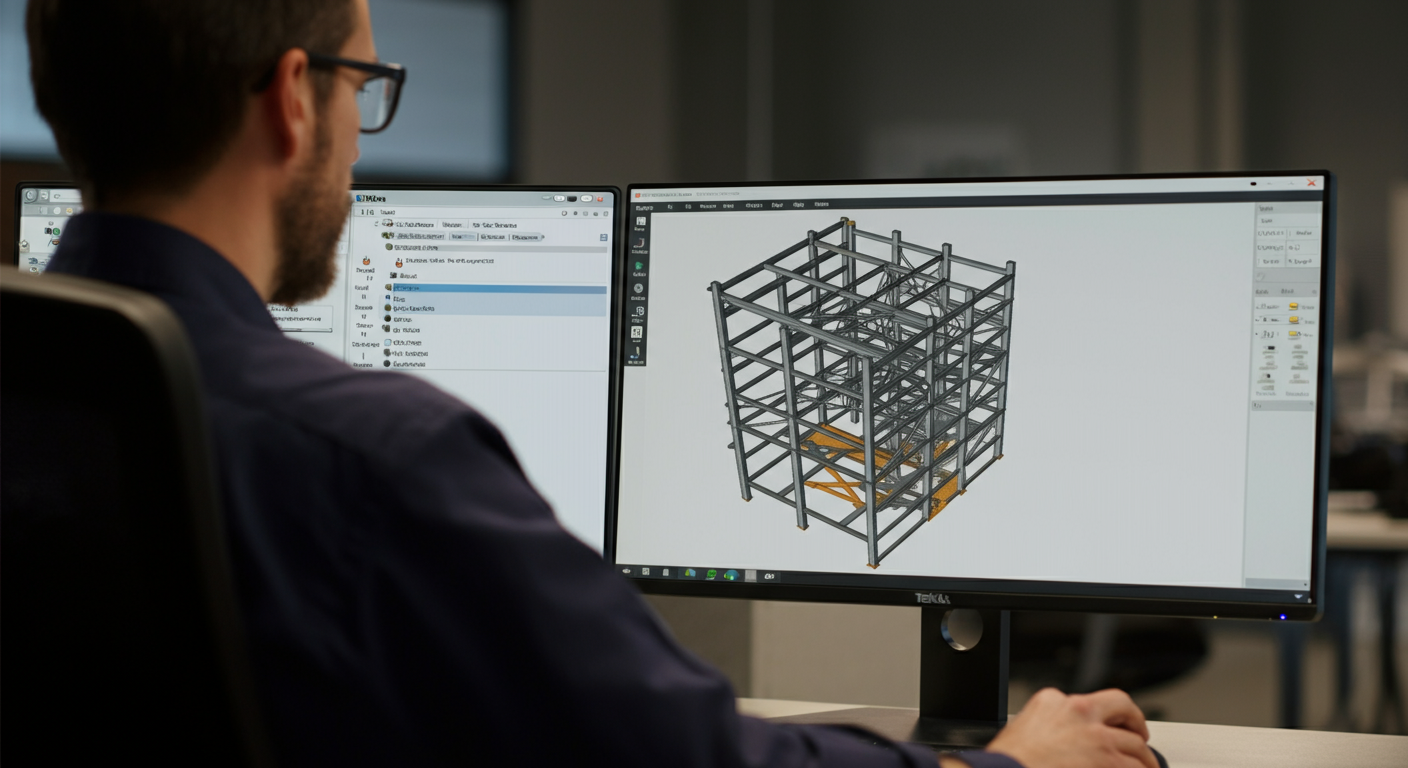
Building a detailing portfolio is more complicated than it sounds. Most of the work you produce belongs to your employer or your client. The drawings are often confidential. The project names may be restricted. And unlike an architect or graphic designer, you can't just post a PDF of your best work on Behance and call it a portfolio. But the challenge is solvable — and a strong portfolio, built the right way, makes a real difference whether you're a junior detailer looking for your next role, a small firm trying to win a new fabricator's confidence, or an experienced detailer trying to make the case that you can handle a more complex scope. What fabricators and hiring firms actually want to see isn't polished graphics — it's evidence that you can produce accurate, organized, code-compliant drawings that hold up through submittal review. This post shows you how to demonstrate that, even when you can't show the drawings themselves.
Why a Steel Detailing Portfolio Is Harder to Build Than Most
In most design fields, your portfolio is your work product. In structural steel detailing, your work product is almost always someone else's intellectual property. Shop drawings belong to the fabricator or the detailing firm. EOR-stamped design documents are confidential. General contractors often have explicit contractual restrictions on distributing project materials — especially on federal, institutional, or high-security jobs.
Beyond the legal dimension, there's a practical one: most shop drawings look similar to someone who doesn't know what they're looking at, and they look technically identical to someone who does. Two erection plans side by side might show completely different levels of detailing skill, or one detailer's ten-hour effort versus another's three. A fabricator evaluating your structural steel detailing work samples can't tell the difference just by glancing at the sheets.
This is the core problem: the quality that matters most — accuracy, coordination rigor, connection logic — isn't visible in a thumbnail.
What to Include When You Can
Even under confidentiality constraints, you can almost always describe the work. That description, done well, is more informative than a stack of anonymous PDFs.
Project Type and Scale
Start with what the project was and how large it was. Multi-story commercial office building, 14 stories, roughly 3,200 tons of structural steel. Pre-engineered metal building with mezzanine and hung crane rail. Single-story warehouse with HSS moment frames and metal deck. Scale signals complexity. Type signals familiarity with a particular set of loading conditions, connection types, and coordination requirements.
Member Types You've Detailed
Be specific. "Structural steel" is not a portfolio entry. "W-shapes through W36, HSS columns and bracing to HSS12x12x5/8, open-web steel joists with bridging details, 3" metal deck with composite and non-composite conditions, embed plates and lintels" — that's a portfolio entry. If you've handled seismic detailing in SDC C or D, say that explicitly. If you've worked on a project governed by AISC 341 provisions, that's meaningful.
Software and Deliverables
List the platform and what you produced with it. Tekla Structures, full 3D model and complete shop drawing package. SDS/2, connection design and detail sheets. AutoCAD with a standards library, 2D erection plans and typical details. If you've done clash coordination in Navisworks, issued DWF files for EOR review, or worked within a BIM execution plan on a Design-Build job, include it. Fabricators evaluating detailers want to know you can operate within their workflow, not just draw steel.
Your Specific Role
This is probably the most overlooked element of a strong portfolio. "Part of a team" is not a role description. Tell the reader whether you ran the full package start to finish, or whether you detailed one portion of a larger project under a senior detailer's QC. If you handled connection design, say which connections and under what standard — AISC 360, RCSC for slip-critical bolts, AWS D1.1 for welded connections. If you coordinated directly with the EOR on RFIs, note that. If you processed submittals and managed revision cycles through IFC, that's operational experience worth stating.
Getting Permission to Use Project References
The most direct path is simply asking. Most employers and clients will grant permission for a general project reference — project type, location (city or region, not always the owner's name), scale, your role — even when they won't allow you to distribute drawings. Get that in writing, even if it's just an email acknowledgment.
For small detailing firms, the conversation with fabricator clients is usually easier than it sounds. A statement like "We'd like to reference this project in our qualifications — we'd describe the scope and our role but wouldn't distribute any drawings or identify the owner" lands differently than asking to post drawings publicly. Most fabricators understand the professional development context and will say yes.
If you genuinely cannot get permission for a project, you can still reference it in a direct conversation as a qualifications example — you just can't put it in a publicly distributed document.
What Makes a Strong Portfolio Entry
The format that works: project context, your specific contribution, outcome.
Project context answers: What was this building? What was the structural system? Was this a design-build job, a traditional DBB job, or a negotiated contract? What made it technically interesting — cantilevers, transfer beams, exposed architectural steel, seismic requirements?
Your contribution answers: What did you produce, what decisions did you make, and what did you coordinate? Did you develop the connection design from the EOR's design criteria? Did you resolve a column base plate conflict with the civil engineer's anchor bolt layout? Did you produce the erection sequence drawings that the iron workers used in the field?
Outcome answers: What happened? First-pass submittal acceptance is worth saying out loud. Zero fabrication errors on a 400-ton package is worth saying out loud. A tight IFC schedule that the fabricator hit because the drawings were clean — that's worth saying out loud.
The combination of context, contribution, and outcome gives a reader everything they need to evaluate your capability without ever seeing a single sheet.
Digital Portfolio Formats That Work
A clean PDF document with three to five project entries, formatted consistently, is still the most functional format for sharing with fabricators or hiring firms. Keep it under 10MB. Use screenshots of model views, connection detail thumbnails (where permitted), and a short narrative block for each project.
Tekla and SDS/2 model screenshots can be highly effective if chosen carefully — an isometric view of a complex connection cluster, a rendered model showing a moment frame with labeled member sizes, an erection drawing viewport that shows annotation density and organizational logic. These show process, not just output.
LinkedIn's Projects section is underused in this industry. A brief project description with member types, software, and your role — no drawings required — builds a searchable professional record over time.
What Fabricators Actually Look For
When fabricators evaluate a detailer's portfolio, they're not looking for aesthetic quality. They're looking for evidence of accuracy habits: revision history that goes one round, not five. Drawing organization that an ironworker can navigate without calling the office. Connection details that show the detailer understood the load path, not just the geometry. Notes and callouts that match the fabricator's shop standards.
If you can demonstrate any of those things — through outcomes, through references, through a phone call with your former fabricator client — that matters more than a polished cover sheet.
Niche Depth vs. Broad Variety
A portfolio that shows eight years of multi-story commercial steel in the Southeast will usually outperform one showing a hospital, a parking deck, a bridge approach (scope mismatch), a food processing facility, and a stadium. Depth signals pattern recognition — you know what the EOR is likely to ask for before they ask, you know where the coordination issues appear in the structural system, you know what connection types the fabricator can run efficiently.
If you have a genuine specialty — seismic design in SDC C/D, long-span joist and deck coordination, exposed architectural steel — lead with it, not with variety.
How NRSteel Approaches Project Showcasing
At NRSteel, we work exclusively with fabricators on commercial and institutional structural projects, primarily across the Southeast. When we're qualifying for a new relationship, we describe projects in exactly the terms above: building type, structural system, member types, our scope, and the outcome. We don't lead with marketing materials. We describe a project that matches the fabricator's scope, explain what we did and how it performed, and let them ask questions.
That approach tends to start real conversations faster than a portfolio deck ever does — because it positions the discussion around their project, not our credentials.
If you're a fabricator evaluating detailing partners for an upcoming commercial or institutional project, NRSteel is worth a conversation. We work across the Southeast and nationally, with direct engineer access, same-timezone response, and a track record of clean first-pass submittals. Get in touch to discuss your next job.