




BIM Coordination and Steel Detailing: What Fabricators Should Expect
BIM Coordination and Steel Detailing: What Fabricators Should Expect
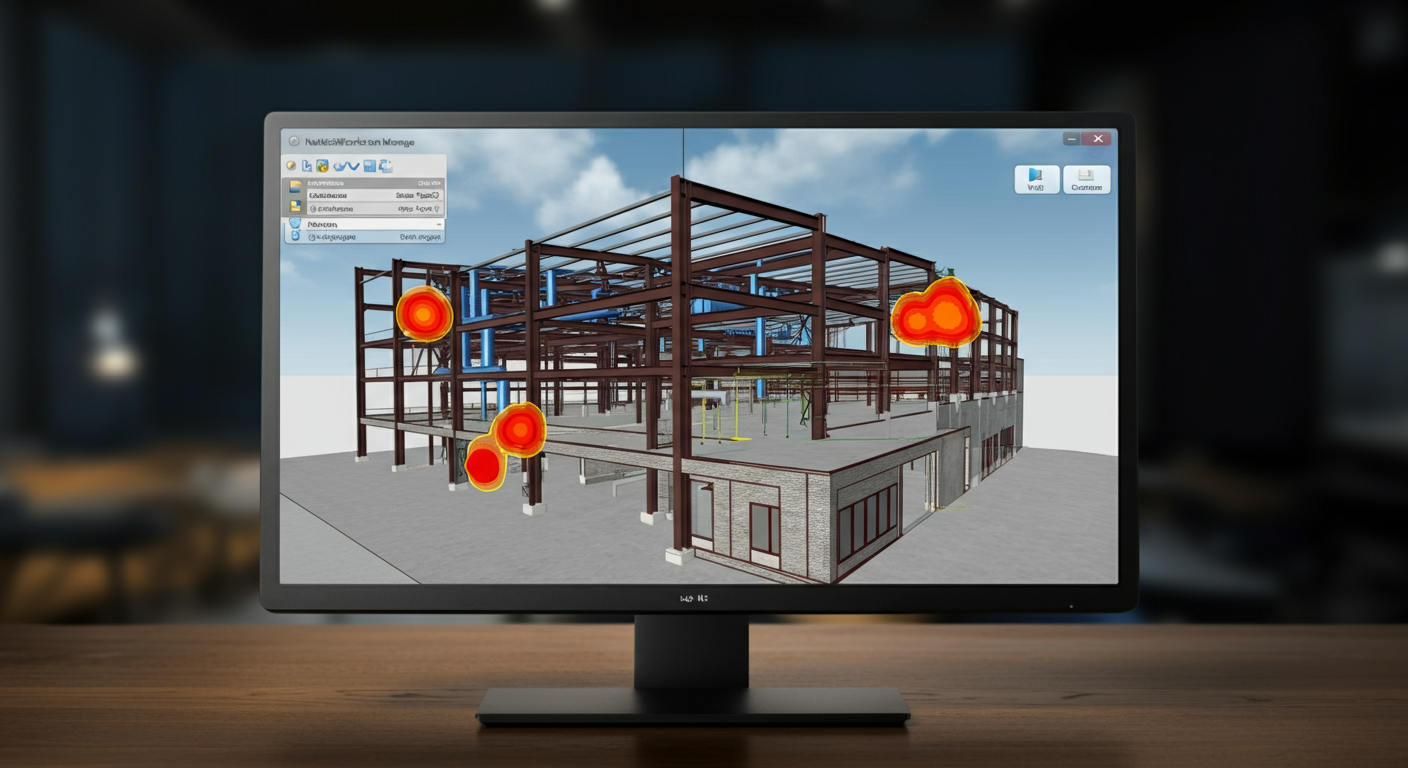
BIM coordination used to be a large-project premium — stadium work, hospital construction, major institutional projects where the GC had a full VDC team. Mid-size commercial work in the Southeast now routinely includes BIM coordination requirements in the specifications, and fabricators who don't have a detailer equipped to participate in that process are showing up to coordination meetings unprepared. The steel detailer's role in BIM coordination is specific: you model the structural steel to the required Level of Development, export coordination-ready files in the formats the GC specifies, participate in clash detection, and generate RFIs from model conflicts before they become field problems. That scope has a hard edge — it's not a catch-all for every trade coordination issue on the project. This post defines what competent BIM coordination support from a detailer looks like, so you know what to expect, what to ask for, and what to push back on.
BIM Coordination Is Now a Baseline Expectation
Check the Division 05 spec on any mid-size commercial project in the last three to four years and you'll find BIM execution plan requirements, LOD mandates, and file exchange protocols that weren't there a decade ago. GCs have standardized on Navisworks for clash detection. Owners are requiring federated models as project closeout deliverables. What was once the domain of hospital and campus work has migrated down to office buildings, schools, distribution centers, and municipal facilities.
For fabricators, this means your detailing scope now regularly includes coordination model deliverables in addition to the fabrication and erection drawings you've always needed. Treating BIM coordination as an optional upsell — or assuming your detailer handles it by default without scoping it — is where projects get expensive fast.
What the Steel Detailer's Role Actually Is
In a properly structured BIM coordination workflow, the structural steel detailer is responsible for four things:
Model authoring. The Tekla Structures model is your coordination model. Every W-shape, HSS member, connection plate, embed, lintel, and piece of miscellaneous steel needs to be modeled accurately to the specified LOD before coordination begins. If the EOR's structural drawings show a W18x97 with a moment connection at a column, that connection needs to be in the model — not as a symbolic placeholder, but as a geometrically accurate representation of what gets fabricated.
IFC and NWC export. The GC's VDC coordinator isn't working in Tekla. They're running Navisworks Manage with models from every trade in the building — mechanical, plumbing, electrical, fire protection, concrete structure, architectural. Your detailer needs to export clean IFC files or NWC files (Navisworks Cache) that aggregate correctly into the federated model without geometric errors, misaligned coordinate systems, or file structure problems that force the VDC team to spend an hour fixing imports.
Clash detection participation. Attending coordination meetings — or at minimum, reviewing clash reports and responding in the coordination platform — is part of the role. When a duct conflicts with a beam web, or a sprinkler main is running through a HSS column, the steel detailer needs to be in the room to assess whether a cope, a sleeve, or a beam relocation is the right answer. That's not a decision the MEP coordinator can make.
RFI generation from model conflicts. When a clash isn't resolvable at the coordination level — when the structural drawing and the coordination model disagree, or when the EOR's design creates a conflict the detailer can't resolve without a design change — the detailer writes the RFI. That RFI should be specific: member designation, connection type, conflict description, proposed resolution options. Vague RFIs cost time.
What the Detailer Should Be Delivering
LOD expectations split into two phases. For coordination, LOD 350 is the current standard on most commercial work — structural members, connections, embeds, and sleeves modeled with enough geometric accuracy that clashes are real, not artifacts of undersized bounding boxes. For the fabrication model, you're working at LOD 400: shop-ready geometry, bolt patterns, weld symbols, material grades, finish specifications.
File formats your detailer should be prepared to deliver without hesitation:
- IFC 2x3 or IFC 4 for federated model coordination
- NWC for direct Navisworks workflow integration
- DWG/DXF for GCs using AutoCAD-based coordination tools or for EOR review
- PDF coordination drawing sets when the GC needs 2D overlays for specific trades
If a detailer is uncertain about any of these formats, or tells you they'll "figure out the export when the time comes," that's a flag.
What the Detailer Should Not Be Doing
Scope clarity prevents the most common BIM coordination billing disputes. The steel detailer is responsible for the structural steel model. Full stop.
Concrete structure coordination — anchor bolt locations, embed plates, slab openings for steel members — is typically the concrete contractor's or EOR's responsibility to resolve against the structural model. The detailer provides the embed geometry; they don't model the concrete or own conflicts between slab reinforcing and steel framing.
MEP coordination is the mechanical, plumbing, and electrical contractors' scope. The steel detailer participates in clash resolution when steel is one party to the conflict. They don't become the de facto BIM coordinator for the project because they're the most technically capable person in the room.
If a GC is pushing your detailer to take on full federated model management, model hosting, or coordination platform administration, that's additional scope that should be contracted and priced separately. Fabricators should know when that line is being crossed so they can either protect their detailer's scope or bill it correctly.
The Time-Zone Problem in BIM Coordination
Coordination meetings don't wait. When a GC schedules a 10:00 AM EST clash resolution meeting, attendees need to be at the table — not catching up on overnight comments before their workday starts.
This is where overseas production models create operational risk on BIM-required projects. A detailer whose modeling team is working a 10-12 hour time offset can't attend a morning coordination call in real time. Comments from the meeting get relayed, interpreted, and acted on hours later. When that cycle repeats across ten coordination rounds over a six-week window, the cumulative lag translates into missed clash resolutions, late RFIs, and field problems that should have been caught at the desk.
Same-timezone detailing isn't a soft benefit on these projects. It's a workflow requirement.
Common Coordination Failures and Who Owns the RFI
The most expensive coordination failure is the clash that gets detected, noted in a meeting, and then not actioned. Here's how responsibility typically breaks down:
- Clash not caught in model review: If the detailer's model was incomplete or geometrically inaccurate at LOD, that's the detailer's error. The fabrication drawing that follows a bad coordination model is a fabrication error waiting to happen.
- Clash detected but RFI not generated: If a conflict requires an EOR decision and the RFI wasn't written, no one is going to resolve it on their own. The detailer who identifies the conflict owns the RFI.
- Field conflict after approved coordination: If the model was accurate, the clash was resolved, and the RFI was answered, but the field condition doesn't match — that's a different problem. Check the structural drawings against the approved model and trace the discrepancy.
Fabricators get caught in the middle of these disputes. Knowing the accountability structure helps you know who to push.
Questions to Ask Your Detailer Before a BIM-Required Project
Before you commit your detailer to a project with explicit BIM coordination requirements, get direct answers to these:
1. What LOD can you model steel connections to — 300, 350, 400?
2. What export formats do you deliver: IFC, NWC, DWG?
3. Who attends the coordination calls — the modeler, a project manager, or no one?
4. What coordination platform does the GC use, and have you worked in it before?
5. How do you handle RFI generation from model conflicts?
6. What's your typical turnaround from coordination meeting to revised model export?
If the answers are vague, or if the detailer hasn't been through a Navisworks coordination workflow before, you'll find out during the project at the worst possible time.
How NRSteel Handles BIM Coordination
NRSteel works exclusively in Tekla Structures. Coordination-ready IFC and NWC exports are part of standard scope on BIM-required projects — not a line-item add. Every project has a single point of contact who attends coordination calls, reviews clash reports, and generates RFIs directly from model conflicts.
Because we're NC-based and working Eastern time, there's no lag between a 10 AM coordination meeting and a model update. When the GC's VDC coordinator needs a revised export before end of day, it happens end of day — not the following morning after an overnight relay.
We understand the fabricator's window. Coordination doesn't resolve on the GC's schedule only — it has to resolve in time for your shop to cut steel.
If you're evaluating detailing partners for a project with BIM coordination requirements, contact NRSteel for a scope review. We work exclusively with fabricators on structural commercial and institutional projects and can walk through what coordination deliverables your specific project will require before you're on the hook for them.