




Automated Drawing Checks: What Modern Software Can Catch That Manual Review Misses
Automated Drawing Checks: What Modern Software Can Catch That Manual Review Misses
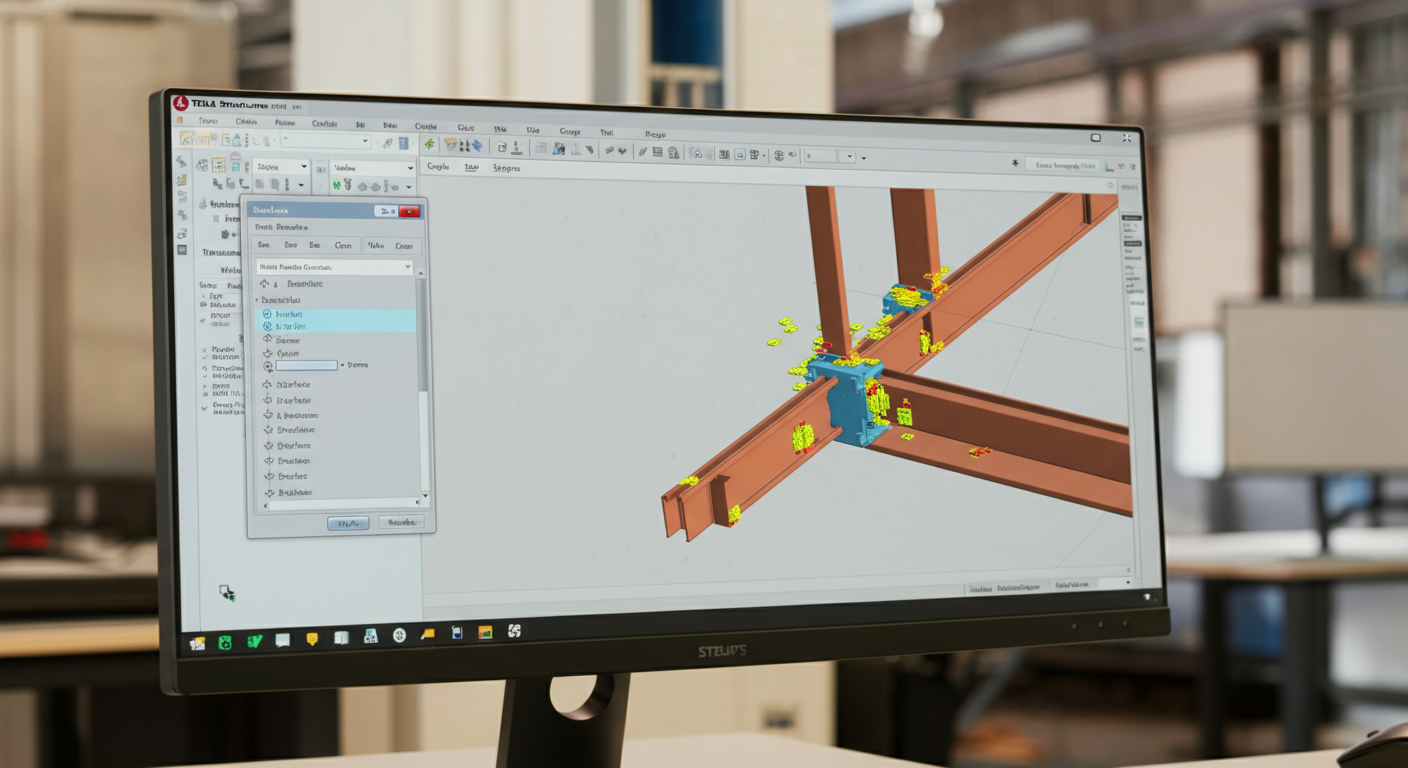
Manual drawing review is not a reliable QA process. The problem is physics, not diligence. A human reviewer checking a 200-sheet package under schedule pressure will miss things. Studies in other engineering fields consistently show that sequential human review catches 70–85% of errors under normal conditions. In steel detailing, the errors that slip through manual review tend to be systematic: the bolt that's consistently 1/4" short of edge distance across a connection type, the assembly mark that doesn't match its reference on the erection plan, the member that conflicts with a column it doesn't appear near on any single drawing. Modern detailing software — Tekla Structures in particular — has built-in model checking and rule validation that catches a specific category of these errors before a drawing is ever printed. This post covers what automated checks actually do, where they reliably work, and where they stop being useful so you understand what your detailer's QC process should look like.
The Limits of Manual Drawing Review
The problem with manual review isn't diligence — it's cognitive load. A senior detailer checking a 150-sheet package for a multi-story steel frame is tracking assembly marks, erection sequences, connection geometry, BOM quantities, weld symbols, bolt patterns, and dimensional strings simultaneously. At sheet 80, the reviewer's attention to edge distance tolerances is not the same as it was at sheet 10.
More importantly, manual review is inherently local. A reviewer checks one drawing at a time. They cannot simultaneously hold the full model state in memory and compare every assembly mark reference across a set. The errors that slip through are almost never random — they're the ones that require cross-referencing two or three sheets at once, or pattern-matching a single value across 40 connection details. These are precisely the tasks automated steel drawing checks are built to handle.
What Tekla's Model Checks Actually Do
Tekla Structures includes a model check framework that runs validation against the model database, not against printed drawings. This distinction matters. By the time a drawing is produced, the geometry, mark assignments, and BOM data are already baked in from the model. Running checks at the model level catches errors before they propagate into the drawing set.
Tekla's built-in model checking covers several categories:
Clash detection identifies physical intersections between parts. A column that penetrates a beam flange, a brace that conflicts with a gusset plate, a stiffener that overlaps a shear tab — these are flagged geometrically before the drawing is issued. Clash detection runs in 3D across the full model, not sheet by sheet.
Reference consistency checks validate that assembly marks are unique and properly referenced. If an assembly mark appears on an erection plan but has no matching detail drawing, or if two separate assemblies share a mark, the model check flags the conflict.
Part and material validation confirms that every part in the model has a grade, size, and finish assigned. A W8x31 that's missing its ASTM A992 designation, or an HSS4x4x1/4 without a finish callout, will surface during model validation rather than on an RFI after submittal.
Rule-Based Checking: Bolt Clearances, Edge Distances, Weld Access
Beyond geometric clash detection, rule-based automated checks apply code and fabrication requirements to connection geometry. This is where steel detailing quality control software earns its keep for fabricators.
Minimum edge distances per AISC Table J3.4 can be validated automatically. A bolt pattern that works in principle but puts a 3/4" bolt hole 7/8" from a plate edge — short of the 1" minimum — is a systematic error that will recur across every similar connection in the job. Automated checking catches the pattern. Manual review catches the instance, if you're lucky.
Bolt clearance checks verify installation and tightening clearance against AISC and RCSC requirements. For snug-tight or pretensioned assemblies, there's no substitute for verifying that a spud wrench or tension-control wrench can physically reach the nut. Rule-based checks apply dimensional clearance criteria to every bolt in the model.
Weld access and cope geometry can be flagged when a configuration doesn't meet AWS D1.1 access requirements or when a coped beam end violates dimensional limits that could cause stress concentrations at the cope radius.
These aren't judgment calls — they're rule applications. Automated checking handles them exhaustively and consistently across every connection in a 500-member model. A human reviewer doing the same job would need to check each one individually.
Drawing Completeness Checks
Tekla's drawing review automation also includes completeness validation at the drawing output stage. Before a drawing is released, the system can verify:
- Every part visible in the view has a mark callout
- BOM line items match parts present in the drawing view
- Weld symbols are present on assemblies flagged as welded connections
- Assembly titles, sheet numbers, and revision blocks are populated
- Referenced drawing numbers exist in the drawing register
These checks address a class of errors that's different from geometric errors — administrative and organizational errors that are easy to introduce during drawing production and hard to catch on a visual review pass. A missing BOM entry doesn't announce itself. An unmatched assembly reference on an erection plan looks fine until the ironworker on-site is holding a piece with a mark that doesn't appear anywhere in the erection drawing package.
What Automated Checks Cannot Catch
Automated checking is not a substitute for engineering judgment, and it's important to be clear about where the boundary is.
Constructability is not a rule set — it's experience. A connection that passes every geometric check may still be extremely difficult to install in the field. Bolt access in a tight corner, the sequence in which members have to be erected to make a joint work, the practicality of a field weld in a high bay with limited access — none of these are things a model check can evaluate.
Engineer intent requires interpretation. If the EOR's connection design specifies a minimum weld size and the detailer has provided a larger weld, that may be acceptable, conservative, or it may conflict with heat input restrictions in a seismic application. The model check cannot parse the design intent behind a value — it can only verify that a value exists and falls within a defined range.
Code interpretation edge cases require judgment. Seismic detailing requirements under AISC 341 for SDC D and above involve member proportioning checks, panel zone requirements, and protected zone restrictions that require a detailer who understands the underlying intent — not just a rules engine.
This is why automated checking is a filter, not a sign-off.
The Human Reviewer's Role After Automated Checking
When automated checks have cleared a model and drawing package, the human reviewer's attention is freed up for higher-order review tasks. This is the point of layered QC — not to remove the human reviewer, but to make their time count.
After automated checks run, the reviewer focuses on:
- Constructability and erection sequence — Does this connection work given the sequence the ironworkers will actually use? Are there erection aids called out where needed?
- Connection consistency with EOR design intent — Do the connections reflect the design assumptions in the contract documents? Are load paths clear?
- Drawing communication quality — Are the details clear enough for the fabricator's shop floor? Are ambiguous conditions shown from multiple views?
- Coordination with the full project scope — Does this steel interact with concrete, MEP, or architectural elements that aren't visible in the structural model alone?
These are exactly the tasks that human reviewers are good at and that automated checking is not designed to handle.
Layered QC: How a Real Process Works
A defensible QC process in steel detailing isn't a single pass — it's a sequence. At NRSteel, the workflow runs: model check after connections are placed, automated rule-based checking before drawings are generated, detailer self-review against the drawing set, and PM sign-off before release to the fabricator.
Each layer catches a different category of error. The model check catches geometry conflicts and reference errors. Rule-based checking catches code and clearance violations. Detailer review catches communication and constructability issues. PM sign-off verifies completeness against the contract scope and confirms coordination with outstanding RFIs or EOR clarifications.
The result is that by the time drawings reach the fabricator's shop, the systematic errors — the ones that generate RFIs, revision cycles, and field problems — have been filtered out at the desk rather than discovered on the floor.
What to Ask Your Detailer About Their QC Process
If you're evaluating a detailing firm, these questions cut through the sales pitch quickly:
- Do you run model checks before generating drawings, or after?
- What rule sets do you apply for bolt edge distances and clearances?
- Who reviews drawings after automated checking, and at what point in production?
- What's your typical RFI rate per 100 sheets on a mid-size commercial job?
- Can you walk me through how a revision gets processed from EOR markup to revised drawing?
A detailer who can answer these questions specifically is running a real process. A detailer who talks generally about "quality" and "experience" without describing a process is relying on individual performance — which is exactly as reliable as the individuals on any given day.
If you're evaluating detailing partners and want to understand how NRSteel's QC process applies to your specific project scope, reach out for a scope review. We work exclusively with fabricators on commercial and institutional structural steel — and we're happy to walk through our process before you commit to anything.