




AI in the Fab Shop: What's Real in 2026 and What's Still 3 Years Out
AI in the Fab Shop: What's Real in 2026 and What's Still 3 Years Out
Every construction technology vendor has an AI story right now, and most of those stories exist somewhere between a working pilot and a well-produced demo. That gap matters when you're deciding where to spend money, where to train people, and what workflows to invest in building. In the steel fabrication and detailing world specifically, AI in 2026 is not theoretical — there are tools in active use, producing real productivity gains on real projects. There are also plenty of capabilities that are 12 to 36 months from being production-ready, and a handful that are further out than any vendor will tell you honestly. This post is our attempt to draw that line clearly, based on what we've tested, what we've seen deployed on actual projects, and what we understand about where the technical obstacles still live. We'll tell you what's real right now, what's close, and what's still a roadmap slide — so you can make decisions based on the technology that exists rather than the technology someone is selling.
The Framing Problem With Most AI Coverage
Construction technology media tends to cluster at two failure modes: breathless early adoption coverage that treats a funded pilot as a shipped product, and reflexive skepticism that dismisses anything not yet in the AISC manual. Neither is useful when you're running a fab shop and deciding whether to retrain estimators, invest in camera hardware, or commit to a new detailing workflow.
The honest framing is that AI adoption in fabrication and structural detailing is happening in discrete layers, each with its own maturity level. Document handling and language tasks are already mature. Computer vision QC is mid-deployment. Automated engineering and closed-loop fabrication are in genuine pilot phases. Autonomous model generation is still mostly aspirational. Understanding which layer a given tool sits in is the only way to evaluate it fairly.
What's Genuinely Deployed Right Now
LLMs in Document Workflows
Large language models are producing real value today in every part of the workflow that involves reading, parsing, and drafting documents. This includes specification review, RFI drafting, submittal log management, and project document cross-referencing.
In practice: a detailer or PM feeding a 300-page project specification into a well-configured LLM interface can extract connection design criteria, special inspection requirements, and seismic SDC designations in minutes rather than hours. The same workflow surfaces conflicts between the structural drawings and the spec that would otherwise surface as an RFI at the worst possible time — three days before IFC issue. We've used these workflows internally on live projects and the time savings on spec review alone are substantial.
RFI drafting is similarly mature. An LLM that has access to the project drawings, the spec, and the RFI log can draft technically accurate RFIs with appropriate AISC 360 or AWS D1.1 references faster than most junior staff. The output still requires engineer review — you are not removing engineering judgment from the loop — but the drafting burden drops significantly.
What these tools cannot do reliably: make engineering decisions, interpret ambiguous geometry in drawings, or replace the judgment of someone who has actually read the full contract documents. They're research assistants and drafting aids, not engineers.
Computer Vision in Quality Control
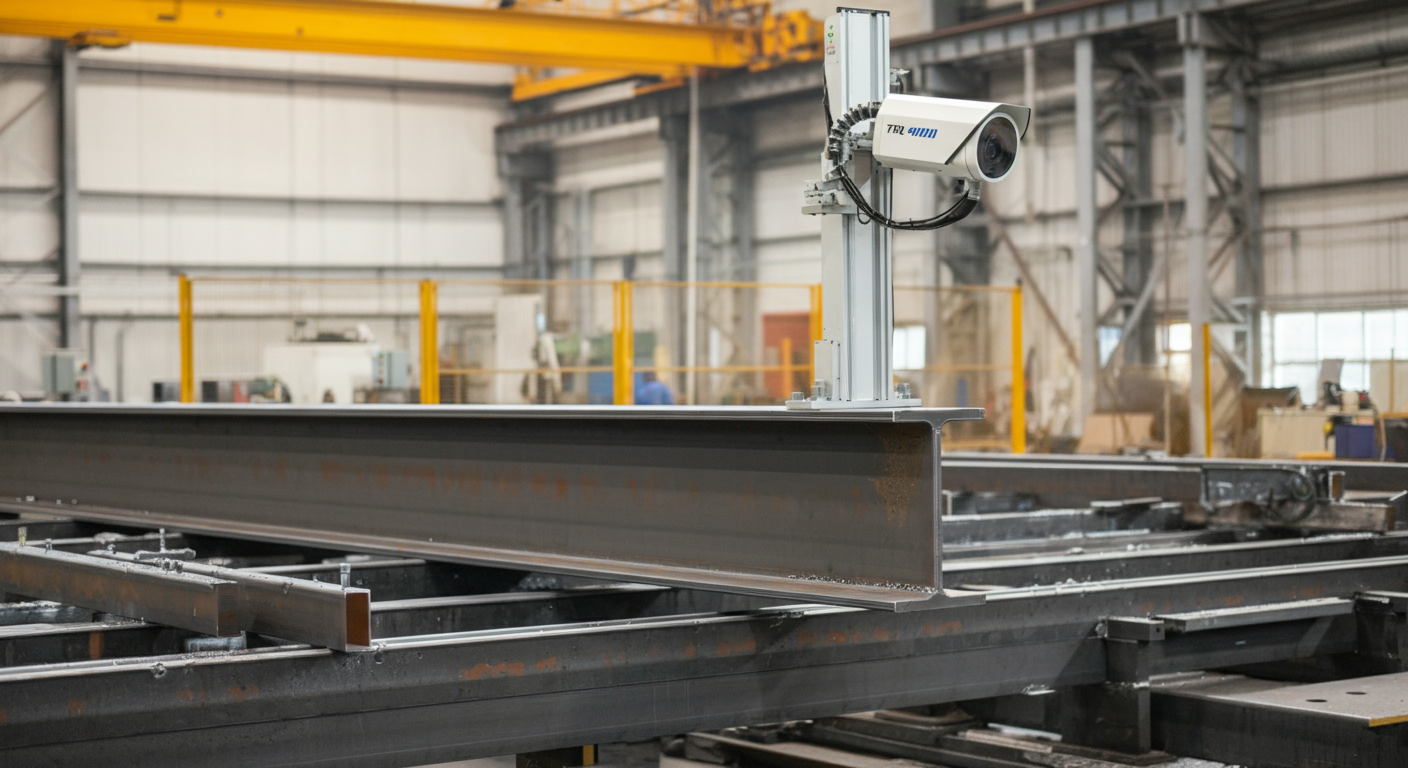
This is the area where AI in steel fabrication has moved from pilot to genuine deployment fastest. Camera-based dimensional verification systems are now running in production at a meaningful number of fab shops. These systems capture as-fabricated geometry of beams, columns, and connection plates and compare against the model geometry, flagging deviations before pieces leave the shop floor.
The productivity case is straightforward: catching a mislocated clip angle or a missed coped corner in the shop costs you a correction and maybe a day. Catching it in the field costs you a crane hold, a field modification RFI, a schedule delay, and a change order conversation nobody wants. Several fabricators we work with have cut field RFIs traceable to dimensional errors by 30–40% after deploying vision-based QC on high-complexity members.
Current limitations are real. These systems perform well on standard W-shapes and HSS members with clean, well-lit shop environments. Performance degrades on complex assemblies with dense connection geometry, on galvanized or painted surfaces in certain lighting conditions, and on anything with highly irregular geometry. The vendors will not lead with this in their demos.
AI-Assisted Connection Design: Honest Assessment
Several platforms now offer AI-assisted connection design tools — automated selection of connection type given loading conditions, bolt patterns, and plate geometry. These are useful in a narrow but real band: preliminary design checks, rapid iteration on standard configurations, and verification against AISC 360 tabulated values.
What they are not doing reliably in 2026: handling seismic collector connections in higher SDC categories, moment frames with project-specific EOR criteria, or anything where the connection design is genuinely governed by geometry constraints rather than capacity. The tools are good enough to reduce engineering hours on the straightforward 80% of connections in a typical commercial project. The remaining 20% — the ones that actually require an engineer — still require an engineer.
Robotic Fabrication With ML Optimization
Robotic coping, drilling, and beam line automation have been running in production for years. The AI layer being added now is primarily scheduling and sequencing optimization: ML systems that analyze an incoming fabrication package, the current shop load, material delivery windows, and erection sequence to generate optimized shop routing and release schedules.
This is real and it's running in larger shops. The practical impact is most visible in shops processing 200+ tons per week where sequencing inefficiency is a measurable cost. For smaller shops, the overhead of integrating these systems against the scheduling benefit hasn't reached a positive ROI for most operations yet. That inflection point is probably 18–24 months out as the software platforms commoditize.
What's 2–4 Years Out
The capabilities that are in legitimate late-stage development and likely to be production-ready within this window:
Drawing interpretation at scale. Systems that can reliably read structural PDFs — framing plans, connection details, schedules — and extract structured data for model population. The technical problem is significant: structural drawings are not standardized documents, and the gap between "usually correct" and "reliable enough for fabrication" is enormous. Tools exist today that work well on clean, modern drawing sets from organized EOR offices. They fail on older drawing conventions, handwritten revisions, and anything with ambiguous symbology. Closing that gap is an active engineering problem with serious capital behind it.
Closed-loop QC with automated disposition. The next generation of shop vision systems won't just flag deviations — they'll integrate with the shop management system to automatically queue re-work, update the model, and generate RFI documentation. This exists in prototype. It will be a real product in 3 years.
What's 5+ Years Out
Autonomous structural detailing — a system that takes architectural and structural intent and produces fabrication-ready Tekla models without engineer oversight — is not close. This is not a conservative take; it's a technical one. The information required to produce a correct fabrication model includes project-specific engineering decisions, EOR preferences, fabricator shop standards, regional code interpretations, and connection design judgment that no current system encodes reliably. The partial automation tools will continue to improve. Removing the engineer from the loop entirely is a different problem class.
Full model generation from structural PDFs as a production-ready workflow falls in the same category. Useful automation, yes. Replacing a detailer, no.
How to Make Good Decisions Now
The fabricators and shops making smart technology decisions in 2026 are doing three things: deploying document-layer AI aggressively because the tools are mature and the ROI is clear, piloting vision-based QC on high-volume standard members where the risk is manageable, and tracking — but not yet committing capital to — the drawing interpretation and model generation tools that are 18–36 months from production readiness.
The worst decision is waiting for certainty before adopting anything. The second-worst is adopting tools because a vendor has a compelling demo for a capability that isn't production-ready. Know which layer you're buying.
The detailing side of this equation matters too. A detailing partner who understands where the AI tools sit in the workflow — and who is already integrating the mature ones into spec review, RFI management, and drawing coordination — reduces your total project cost and your RFI exposure. That's not a technology argument. It's a project delivery argument.
If you're evaluating detailing partners for your next project, contact NRSteel for a scope review. We work exclusively with fabricators on commercial and institutional structural projects and we're happy to talk through how your current workflow maps to where the technology actually is.