




AI and Connection Design: What the New Tools Can Do (and Where They Need an Engineer)
AI and Connection Design: What the New Tools Can Do (and Where They Need an Engineer)
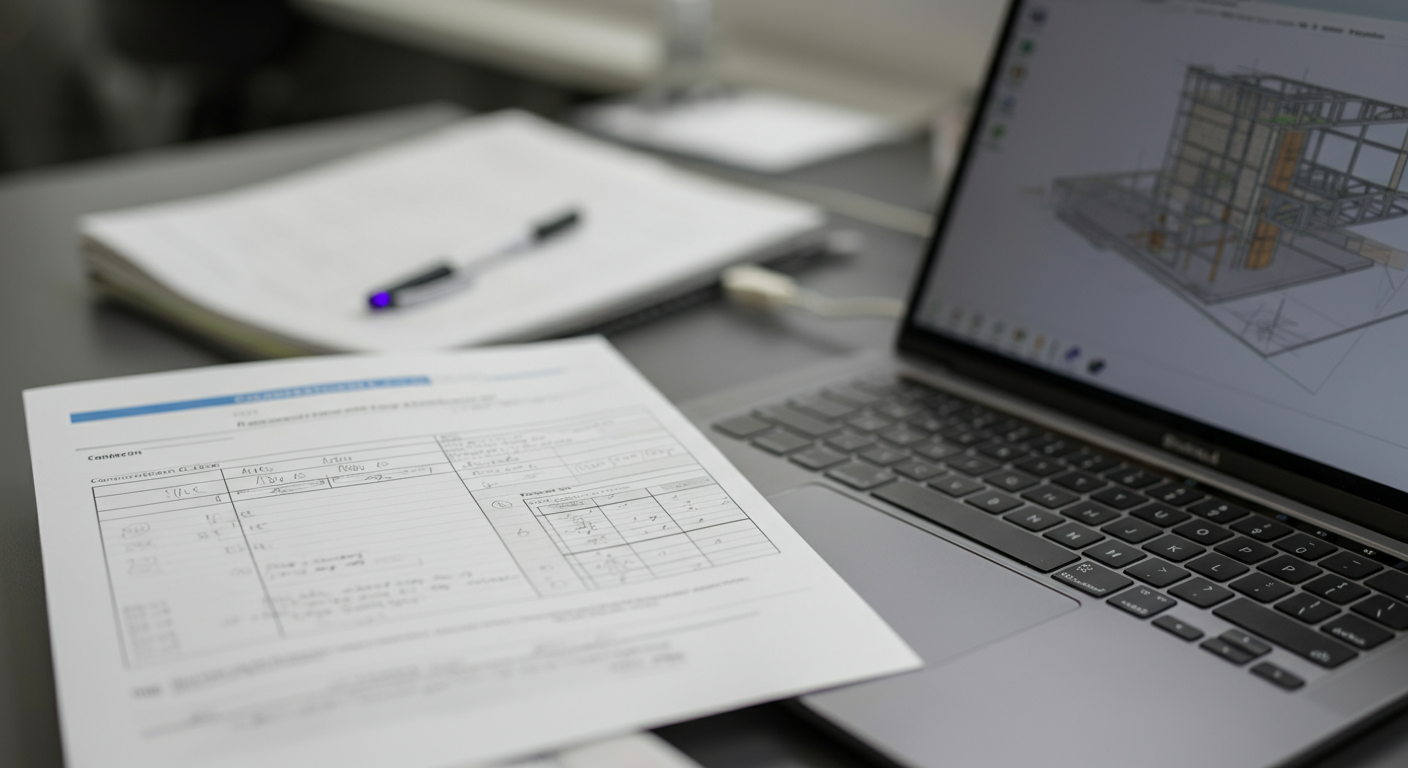
Connection design sits at the intersection of geometry, load path logic, material behavior, and code compliance. It's one of the most technically demanding parts of the structural steel process, and AI tools will approach it from the edges long before they can handle it in full. Right now, there are tools that automate routine connection selection from parametric rule sets — Tekla's parametric connections, Idea StatiCa's automated check workflows — but these have existed in some form for over a decade and aren't meaningfully "AI" in the current sense of that word. The genuinely new tools are starting to use machine learning to flag connection conditions that fall outside normal parameters, assist with documentation of design decisions, and accelerate the repetitive checking that currently consumes engineer time on large packages. This post maps what's real in AI-assisted connection design, what the liability structure means for where automation can and can't go, and what both detailers and EORs should be watching.
What Connection Design Actually Requires
Before evaluating any tool, it helps to be precise about what connection design actually involves. A shear tab on a W18x35 framing into a W24x76 girder web looks like a simple problem. In practice, it requires checking block shear, bolt shear, weld capacity, beam web local yielding, coped section flexural capacity if a cope is present, and compatibility with the EOR's load assumptions. AISC 360 Chapter J governs fasteners and welds. The AISC Steel Construction Manual provides design tables for common configurations, but those tables have applicability limits. Add seismic demand — say, SDC C or above under ASCE 7 — and you're now dealing with AISC 341 prequalification requirements, protected zones, and connection ductility provisions that fundamentally change how you approach the geometry.
That's one connection type on a standard member. A moment connection at a column — whether a bolted flange plate, extended end plate, or welded connection per AISC 358 — carries an entirely different set of checks, and the EOR's load combinations need to be explicitly incorporated. Unusual conditions compound quickly: eccentrically loaded weld groups, connections on sloped or skewed members, transfer conditions through diaphragms, connections involving HSS members with punching shear concerns. The knowledge base required is deep, and the consequences of getting it wrong end up on the fabrication floor, or worse, on an erected structure.
Parametric Automation: What It Has Done Well for 15 Years
Tekla Structures has had parametric connection macros for as long as most working detailers can remember. You select a connection type, input the governing loads, and the macro generates geometry, hardware, and weld callouts based on a pre-coded rule set. Idea StatiCa takes a different approach, using FEA-based component modeling to check connections against AISC 360 (or Eurocode, depending on the market). Both tools are genuinely useful. Both have meaningfully reduced the time required to produce a compliant connection detail for standard conditions.
But neither tool is doing what gets described today as "AI." A parametric macro is a deterministic rule set — it applies the same logic every time and produces a predictable output for a given input. Idea StatiCa's solver is sophisticated FEA, not pattern recognition. These tools don't generalize from data; they apply pre-coded engineering logic. Calling them AI in 2025 is like calling a spreadsheet AI because it calculates faster than a person. The distinction matters because it affects how you evaluate their outputs and where you trust them.
What parametric automation has genuinely solved is throughput on routine conditions. A shop with a well-configured Tekla environment can produce dozens of standard shear connections per day with high geometric accuracy. The risk that remains isn't in the geometry — it's in whether the connection type selected was appropriate for the actual load and boundary conditions, and whether edge cases were caught before they became field problems.
Where Genuine ML Tools Are Starting to Enter
The category of tools that can credibly be called AI-assisted — meaning they use machine learning rather than static rule sets — is still small in the structural connection space, but it's growing. A few threads worth tracking:
Pattern recognition from historical project data. Some newer platforms are building functionality that learns from a firm's historical connection library to suggest connection configurations that have been used and approved on similar projects. This isn't code-checking; it's similarity matching. The value is speed on the first pass and consistency across a project team. The risk is anchoring to precedent that may not transfer — past approval doesn't guarantee current compliance if loading, geometry, or applicable codes differ.
Automated condition flagging. This is probably the most immediately useful application. ML tools can be trained to identify connection conditions that fall outside the parameters of a firm's standard library — unusual aspect ratios, framing angles outside normal range, members that trigger secondary checks not visible in the primary geometry. Rather than replacing engineering review, these tools compress the time a senior engineer spends finding the conditions that require attention.
Documentation assist. Large language models are starting to be used to accelerate the generation of connection design narratives, basis-of-design sections, and submittal documentation. This is an area where the efficiency gains are real and the risk is contained, provided someone technically competent is reviewing the output.
The EOR Signature Problem
The liability structure matters here, and it matters a great deal. Connection design in a delegated design arrangement sits under the EOR's overall project responsibility, but the engineer of record for the connection package — whether that's the fabricator's contracted connection engineer or the EOR directly — stamps and signs the calculations. That signature is a legal and professional commitment. It doesn't transfer to a software vendor.
This creates a hard floor on how far connection design automation can advance in actual practice, regardless of what the tools can technically do. An EOR cannot delegate engineering judgment to a black box and satisfy their professional responsibility. A PE stamp on an AI-generated output that the engineer of record doesn't independently understand and verify is an exposure problem, not an efficiency gain.
The practical implication: AI tools in connection design will be most valuable as judgment amplifiers — increasing the speed and coverage of human review — not as judgment replacements. Any vendor claiming otherwise is selling past the liability line.
What "AI-Assisted" Should Mean in an Honest Workflow
A well-integrated AI-assisted connection design workflow probably looks something like this: parametric tooling handles geometry generation and routine code checks on standard connections, which covers 70–80% of connections on a typical commercial framing package. ML-based flagging tools review the full connection set and surface conditions that fall outside normal parameters or carry elevated complexity. The engineer of record — or a licensed connection engineer in a delegated design arrangement — reviews the flagged conditions with full attention and signs off with actual understanding of the governing checks.
That workflow is faster than the current baseline, more consistent, and still defensible under AISC, IBC, and standard-of-care expectations. It doesn't eliminate engineering; it concentrates engineering time where it has the most leverage.
Where an Engineer Still Needs to Be in the Loop
Certain connection conditions will require direct engineering engagement regardless of how the surrounding tooling develops. Transfer conditions involving collector elements and diaphragm force transfer. Moment connections in high-seismic SDC D/E applications with AISC 341 prequalification constraints. Connections on members with non-standard profiles or unusual boundary conditions. Connections where fabrication sequence interacts with erection stability in ways that affect design. These aren't niche situations — they appear on most non-trivial commercial structural projects. They require an engineer who can reason about load path, not a tool that pattern-matches against prior approvals.
The EOR relationship is also inherently engineering work. RFI resolution, design intent clarification, coordination between the connection package and the structural model — these involve professional judgment and communication that isn't automatable in any near-term timeframe.
Implications for Detailers: What to Learn Now
For working detailers, the practical takeaway isn't anxiety about replacement — it's a signal about where to invest time. Proficiency in Tekla's parametric connection environment is already table stakes on commercial work. Understanding how Idea StatiCa models connection behavior, and being able to read and question its output, is increasingly relevant as fabricators and connection engineers use it more widely. Learning the AISC 360 and 341 provisions well enough to recognize when a flagged condition actually matters — and when it doesn't — is where the differentiated value lives.
The detailers who stay most relevant as these tools develop will be the ones who understand what the tools are actually checking, where their applicability limits are, and what conditions fall outside their coverage. That knowledge doesn't come from the software. It comes from experience on real projects and sustained attention to the code.
NRSteel works exclusively with fabricators on structural commercial and institutional projects across the Southeast and nationwide. Our team has direct experience with connection design coordination, delegated design workflows, and the full Tekla environment. If you're evaluating detailing partners for your next project, contact NRSteel for a scope review.